
US Secretary of State’s India visit signals renewed effort to strengthen ties amid trade disputes and Middle East tensions
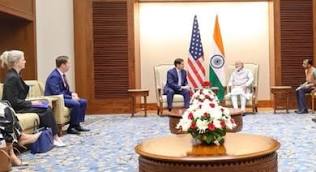
Prime Minister Narendra Modi on Saturday held wide-ranging talks with US Secretary of State Marco Rubio, covering trade, energy security, emerging technologies and regional stability, as Washington extended an invitation for Modi to visit the White House in the near future.
The meeting comes at a crucial time for India-US relations, which have witnessed both cooperation and friction under President Donald Trump, particularly over trade and energy issues.
White House Invitation Extended
Joining Rubio during the meeting was US Ambassador to India Sergio Gor, who later described the discussions as productive and confirmed that Prime Minister Modi had been invited to Washington for talks with President Trump.
According to the US side, the leaders discussed ways to deepen cooperation across security, trade, critical technologies and strategic affairs, while also reviewing developments in the Indo-Pacific region.
Energy Security High On Agenda
A key focus of the discussions was energy security as global markets continue to face uncertainty amid the ongoing Iran conflict and disruptions in the Middle East.
Rubio urged India to expand energy cooperation with the United States, arguing that American energy exports could help diversify India’s supply sources and reduce vulnerabilities caused by geopolitical tensions.
With India importing the majority of its crude oil requirements, concerns over disruptions in vital shipping routes such as the Strait of Hormuz have become increasingly significant.
Modi Discusses Global Security Concerns
Following the meeting, Prime Minister Modi said the two sides reviewed progress in the India-US Comprehensive Global Strategic Partnership and exchanged views on regional and global security challenges.
The discussions are believed to have included developments in West Asia, where tensions surrounding Iran continue to raise concerns about global energy supplies and regional stability.
Modi reiterated that India and the United States would continue working closely on issues of mutual and global importance.
A Relationship Marked By Ups And Downs
India-US ties have experienced a turbulent phase over the past year.
After a strong start following Modi’s visit to Washington in early 2025, trade tensions escalated when the Trump administration imposed steep tariffs on certain Indian imports, citing concerns over India’s continued purchase of Russian oil.
Months of negotiations eventually produced a framework for a broader trade agreement, helping stabilise relations and reducing some of the friction between the two countries.
However, uncertainty in global markets and ongoing geopolitical conflicts have delayed the signing of a final trade deal.
Rubio Visit Seen As Diplomatic Reset
Rubio’s three-day India visit is being viewed by many observers as an effort by Washington to reinforce ties with one of its most important strategic partners in Asia.
Before arriving in Delhi, Rubio visited Kolkata, becoming the first senior US official in over a decade to visit the city. During the trip, he paid respects at the headquarters of the Missionaries of Charity.
His visit also comes ahead of a meeting of Quad foreign ministers involving India, the United States, Japan and Australia, highlighting renewed focus on cooperation in the Indo-Pacific.
Focus Shifts To Next Modi-Trump Meeting
With a White House invitation now on the table, attention is turning to the possibility of another face-to-face meeting between Modi and Trump in the coming weeks.
Such a meeting could provide an opportunity to advance pending trade negotiations, strengthen strategic cooperation and address emerging challenges ranging from energy security to regional stability.
For now, Rubio’s visit appears to have injected fresh momentum into a relationship that remains one of the most important partnerships shaping the global balance of power.