
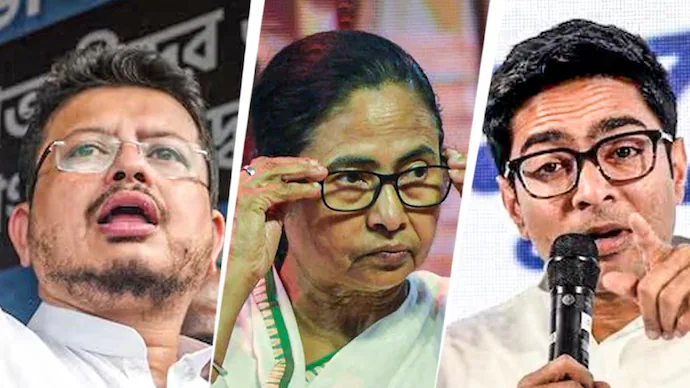
For over a decade, the Trinamool Congress looked unbeatable in West Bengal. Mamata Banerjee had built the party from the ground up, crushed rivals, survived rebellions, and dominated Bengal’s political landscape since 2011.
But just one month after suffering its biggest electoral defeat, the party now finds itself battling a crisis that could prove even more dangerous than losing power.
A revolt led by expelled leader Ritabrata Banerjee has shaken the TMC to its core. More than 100 councillors have resigned, dozens of MLAs have openly defied the leadership, and senior leaders have begun questioning decisions taken at the very top.
The question no longer is whether the TMC lost the election.
The question is whether the party can survive the aftermath.
From Election Defeat to Full-Blown Rebellion
The cracks began appearing immediately after the BJP’s landslide victory, which reduced the TMC to just 80 seats.
While Mamata Banerjee remained largely above criticism, frustration within the party quickly turned towards her nephew, Abhishek Banerjee, who many leaders believe had become the real power centre in the organisation.
Expelled leaders Ritabrata Banerjee and Riju Datta were among the first to voice concerns, accusing the leadership of sidelining grassroots workers and centralising decision-making.
What started as murmurs soon turned into open dissent.
MLAs Begin Distancing Themselves
One of the biggest warning signs came when a majority of TMC legislators simply stopped showing up.
A crucial strategy meeting at Mamata Banerjee’s Kalighat residence saw around 60 of the party’s 80 MLAs absent.
Soon after, a major protest led by Mamata against alleged post-poll violence drew only a handful of legislators and MPs.
For a party once known for strict discipline, the absences spoke louder than any public statement.
Collapse at the Grassroots
The damage was not limited to the Assembly.
Across municipalities, municipal corporations and zilla parishads, TMC councillors began resigning in large numbers.
Many local representatives stopped attending office altogether, while others faced criminal investigations as the new BJP government launched a crackdown on alleged syndicate networks and extortion rackets.
Within weeks, the TMC’s organisational machinery started looking visibly weakened.
The Abhishek Factor
As tensions grew, many leaders privately blamed Abhishek Banerjee for the crisis.
Questions intensified after civic authorities issued notices to several properties allegedly linked to him and his family.
Meanwhile, senior leaders increasingly argued that decisions were being driven by consultants and strategists rather than traditional party structures.
Former MP Kakoli Ghosh Dastidar openly questioned the role of political consultants and resigned from key organisational responsibilities.
The perception that Mamata’s authority was being overshadowed by a smaller inner circle only deepened resentment.
The Signature Controversy That Changed Everything
The rebellion exploded after allegations emerged that signatures of MLAs had been forged on a letter submitted to the Assembly Speaker regarding the Leader of the Opposition’s appointment.
Ritabrata Banerjee and other legislators claimed they had never authorised the resolution.
The accusations triggered a political earthquake.
Within hours, the dissidents were expelled.
Instead of silencing the revolt, the move supercharged it.
Soon, nearly 60 MLAs rallied behind Ritabrata and approached the Speaker seeking recognition as the legitimate legislative group.
The development effectively challenged the authority of the existing leadership and brought the party closer than ever to a formal split.
Why This Crisis Is Different
Political rebellions are not new in India.
The Shiv Sena and NCP witnessed dramatic splits in Maharashtra.
But those battles unfolded over months.
What makes the TMC crisis extraordinary is the speed.
In barely 30 days, a party that ruled Bengal uninterrupted for 15 years has gone from electoral defeat to organisational chaos.
Unlike many regional parties built around ideology, the TMC was largely held together by power, loyalty to Mamata Banerjee and electoral success.
Once power disappeared, those bonds began to weaken rapidly.
Mamata’s Toughest Battle Yet
Mamata Banerjee has survived countless political storms.
She defeated the Left Front, outmanoeuvred national parties and built one of India’s most formidable regional outfits.
But this challenge is different.
For the first time, the threat is not coming from outside the party.
It is coming from within.
Whether Mamata can reunite her fractured organisation or whether Bengal is about to witness a Shiv Sena-style split may determine the future of the Trinamool Congress itself.
One month ago, the BJP ended TMC’s rule.
What followed may prove even more consequential.