
From Trade Routes To Warships, How India Is Expanding Its Naval Strength Amid China’s Growing Presence
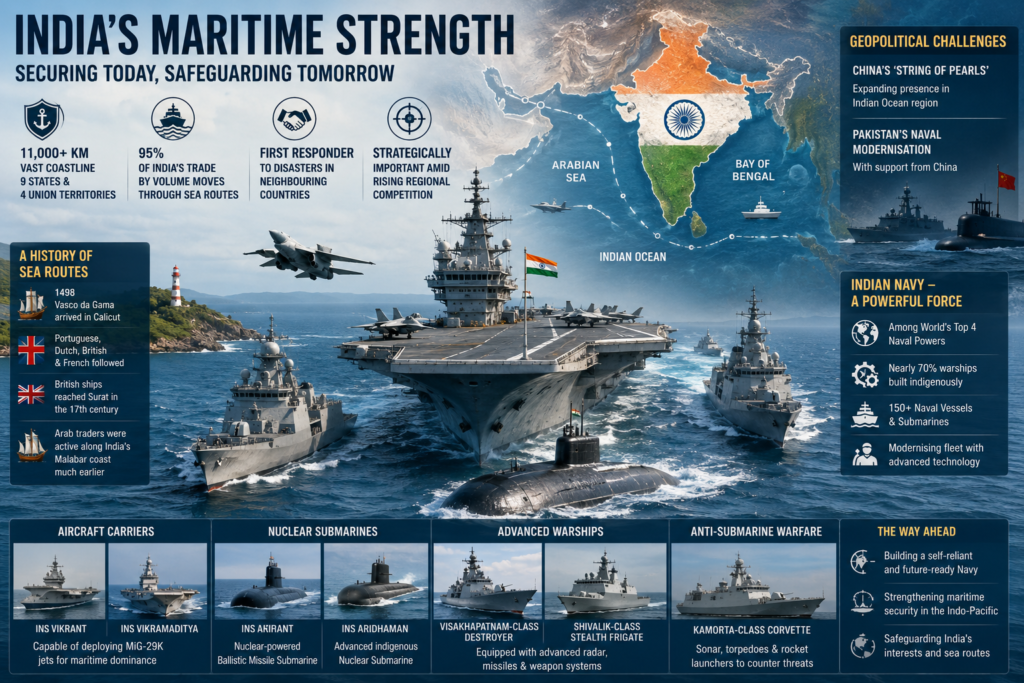
Stretching across more than 11,000 kilometres of coastline and connected to nine states and four Union Territories, India’s maritime boundary has emerged as one of the country’s most important strategic assets.
Surrounded by the Indian Ocean, the Arabian Sea and the Bay of Bengal, India occupies a crucial position in global maritime geography. These waters are not only central to trade and economic activity but also play a vital role in national defence, energy security and regional influence.
Over the years, the Indian Navy has increasingly become a key pillar of India’s strategic ambitions in the Indo-Pacific region. From humanitarian rescue missions to military deterrence, India’s maritime reach continues to expand rapidly.
India’s Seas Have Historically Shaped Foreign Influence
India’s maritime history is deeply linked to foreign trade, invasions and colonial expansion.
European powers first entered India through sea routes and gradually established political control over large parts of the subcontinent. Portuguese explorer Vasco da Gama arrived in Calicut in 1498, opening maritime access for European colonial powers.
The Portuguese were later followed by the British, Dutch and French, all of whom used naval strength and trade routes to expand their influence in India. British merchant ships reached Surat in the early 17th century, eventually paving the way for British colonial rule.
Even before the arrival of Europeans, Arab traders were actively trading along Kerala’s Malabar coast, making India a major maritime trading hub for centuries.
Indian Navy Now Among World’s Most Powerful Naval Forces
Today, the Indian Navy is considered one of the world’s strongest naval forces.
India is widely regarded among the top naval powers globally alongside countries like the United States, China and Russia. The country has significantly expanded indigenous defence manufacturing under its self-reliance push.
According to the Ministry of Defence, nearly 70 percent of India’s warships are now built domestically. India currently operates around 150 naval vessels and submarines while simultaneously modernising older platforms with advanced technology and weapons systems.
The Navy’s increasing capabilities are aimed at securing India’s maritime interests across the Indian Ocean region.
India Accelerating Indigenous Warship & Submarine Production
India has sharply increased investments in indigenous naval projects including stealth frigates, destroyers, submarines and anti-submarine warfare vessels.
Major Indian shipbuilding companies like Garden Reach Shipbuilders & Engineers, Mazagon Dock Shipbuilders Limited and Cochin Shipyard Limited are leading several critical naval projects.
India is also strengthening its anti-submarine warfare capabilities through specialised vessels equipped with sonar systems, torpedoes and underwater detection technologies.
The naval modernisation programme includes offshore patrol vessels, landing craft units, stealth frigates and next-generation destroyers aimed at enhancing coastal and deep-sea security.
Aircraft Carriers & Nuclear Submarines Boost India’s Deterrence
India currently operates two aircraft carriers — INS Vikrant and INS Vikramaditya.
These carriers significantly improve India’s maritime strike capability and can deploy advanced fighter aircraft including MiG-29K jets.
India also possesses a growing submarine fleet that includes nuclear-powered submarines such as INS Arihant and modern Kalvari-class submarines.
The induction of INS Aridhaman further strengthened India’s nuclear deterrence capability in the Indian Ocean region.
Modern Warships Expanding India’s Naval Reach
India’s naval fleet includes destroyers, stealth frigates, anti-submarine corvettes and advanced surveillance ships capable of combat, rescue and intelligence operations.
Warships such as the Visakhapatnam-class destroyers and Shivalik-class stealth frigates are equipped with advanced radar systems and long-range missile capabilities.
The Navy also operates Kamorta-class anti-submarine warfare corvettes designed to detect underwater threats using sonar systems, torpedoes and rocket launchers.
These capabilities are increasingly important as submarine activity rises across the Indian Ocean.
China’s Expanding Presence Raising Strategic Concerns
India’s growing maritime focus is closely linked to rising geopolitical competition in the Indian Ocean.
China has steadily expanded its footprint through investments in ports and maritime infrastructure in countries such as Pakistan, Sri Lanka and Myanmar. This strategy, commonly referred to as the “String of Pearls,” is viewed in India as an effort to increase Chinese strategic influence around the region.
China has also increased deployments of research vessels, surveillance ships and submarines in the Indian Ocean, raising concerns within India’s security establishment.
At the same time, Pakistan has continued modernising its naval capabilities with Chinese assistance, including the acquisition of advanced submarines and maritime defence systems.
Sea Routes Are Critical For India’s Economy
India’s economy remains heavily dependent on maritime trade.
Nearly 95 percent of India’s trade volume moves through sea routes, making naval security essential for economic stability. India also relies heavily on imported oil and gas supplies transported through global chokepoints such as the Strait of Hormuz and the Red Sea.
Growing threats from piracy, regional conflicts, drone attacks and instability in strategic waters have further increased the importance of a technologically advanced navy.
Indian naval forces have also repeatedly acted as first responders during natural disasters in neighbouring countries like Sri Lanka and Bangladesh, carrying out rescue and humanitarian operations through maritime routes.
India Pushing Towards Naval Self-Reliance
India’s long-term objective is to reduce dependence on foreign defence imports and emerge as a self-reliant maritime power.
The government has increasingly encouraged domestic defence firms and private shipyards to participate in naval manufacturing and defence technology development.
With continued investments in indigenous submarines, aircraft carriers, stealth warships and surveillance systems, India is steadily positioning itself as a major Indo-Pacific maritime power capable of protecting its strategic interests across the region.