Court Ends Shared Worship System at Disputed Dhar Site
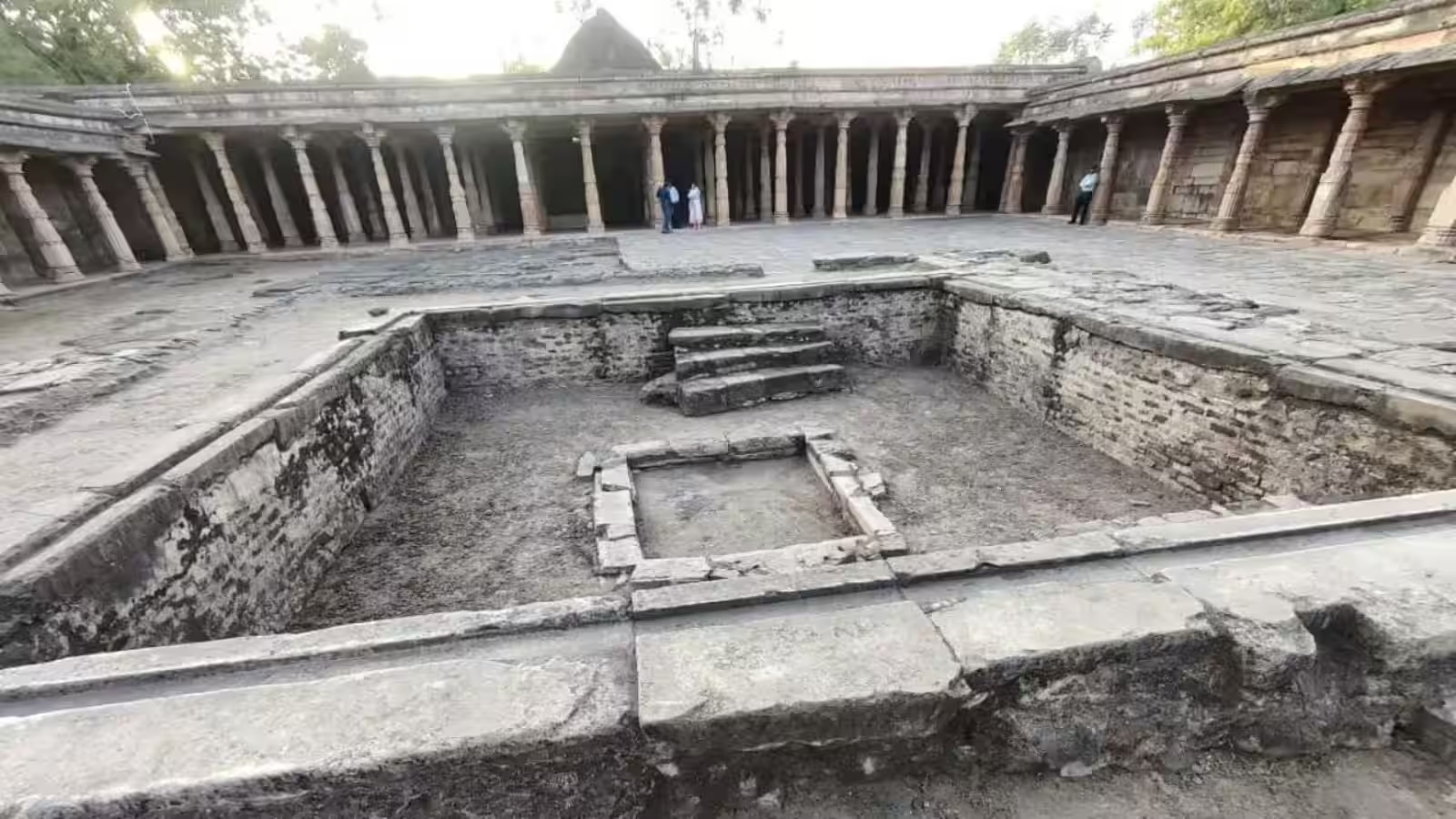
In a significant ruling on the long-standing Bhojshala-Kamal Maula dispute, the Madhya Pradesh High Court on Friday declared the Bhojshala complex in Dhar as a temple dedicated to Goddess Vagdevi Saraswati. The court also cancelled the Archaeological Survey of India’s (ASI) 2003 arrangement that allowed Hindus to perform पूजा on Tuesdays and Muslims to offer Friday namaz at the site.
The verdict was delivered by a division bench comprising Justice Vijay Kumar Shukla and Justice Alok Awasthi. The bench stated that historical records, archaeological findings, and literary evidence clearly establish the religious identity of the monument as a Saraswati temple connected to Raja Bhoj, the Parmar ruler known for promoting Sanskrit education in Dhar.
Court Highlights Historical and Religious Evidence
While delivering the judgment, the High Court observed that Hindu worship at the site had continued over time, even though it remained regulated under administrative arrangements.
The bench noted that historical literature identifies Dhar as a major centre of Sanskrit learning under Raja Bhoj and supports the existence of a temple dedicated to Goddess Saraswati at the Bhojshala site.
According to the court, the available evidence confirms the religious character of the disputed structure as Bhojshala, a temple associated with Goddess Vagdevi Saraswati.
ASI’s 2003 Circular Cancelled
The High Court struck down the ASI’s 2003 circular that introduced the shared worship arrangement at the protected monument. Under that system, Hindus were permitted to conduct prayers on Tuesdays, while Muslims were allowed to offer namaz on Fridays.
This arrangement had remained one of the most controversial aspects of the dispute between Hindu and Muslim groups over the identity and use of the site.
Alternative Land for Mosque Suggested
While ruling in favour of the Hindu claim over Bhojshala, the court also addressed the religious rights of the Muslim community.
The bench stated that the Madhya Pradesh government may consider allotting suitable land within Dhar district for the construction of a mosque if an application is submitted by the concerned Muslim parties.
The court said such a request should be considered in accordance with the law.
Owaisi Compares Verdict to Babri Masjid Judgment
Reacting to the High Court verdict, AIMIM chief Asaduddin Owaisi criticised the ruling and said it resembled the Babri Masjid judgment.
In a post on X, Owaisi expressed hope that the Supreme Court would overturn the order, calling the similarities between the two judgments “glaring”.
Decades-Old Bhojshala Dispute
The Bhojshala dispute has continued for decades and revolves around competing claims over the 11th-century structure in Dhar.
Hindu groups consider the site a temple dedicated to Goddess Saraswati, while Muslim groups identify it as the Kamal Maula Mosque.
The present legal battle emerged through multiple petitions filed before the Madhya Pradesh High Court. Some petitions sought exclusive Hindu worship rights, while others opposed restrictions on namaz at the site.
ASI Survey and Arguments by Petitioners
During the hearings, the High Court ordered a scientific survey of the monument by the ASI. Although the Supreme Court briefly stayed the process, it later allowed a time-bound examination of the survey report and objections raised by different parties.
Lawyers representing Hindu petitioners argued that Bhojshala was originally a Saraswati temple from the era of King Bhoja. They cited inscriptions, architectural features, and archaeological remains as evidence supporting the existence of a Hindu religious structure.
Muslim petitioners argued that records from the Khilji period did not mention the destruction of any Saraswati temple. They also referred to a 1935 “Alaan” issued by the former Dhar ruler that permitted namaz at the site.
Jain petitioners also presented claims, arguing that an idol associated with the complex belonged to the Jain Goddess Ambika. They additionally pointed to similarities between the site’s architecture and Jain temples in Mount Abu.