
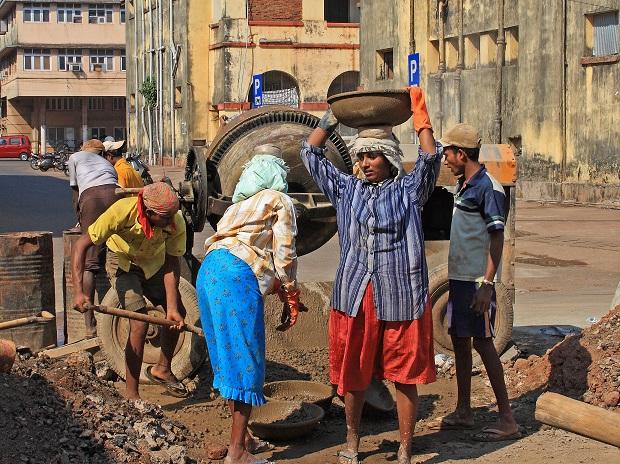
Average Daily Income In Manufacturing, Trade And Services Remains Below Wage Benchmark
A recent survey on India’s unincorporated non-agricultural sector has revealed that average daily earnings of workers in the informal economy remain below the minimum wage benchmark for unskilled labour in many parts of the country.
The findings highlight the continued financial struggles of millions of workers employed in small informal businesses across manufacturing, trade and service sectors.
According to the latest Annual Survey of Unincorporated Sector Enterprises (ASUSE), average daily earnings in several key sectors remain lower than the officially prescribed minimum wage for unskilled non-agricultural work.
Daily Earnings Still Below Minimum Wage Levels
The data shows that average daily earnings stand at around:
• Rs 391 in manufacturing
• Rs 401 in trade
• Rs 420 in other service sectors
All three figures remain below the minimum wage benchmark of nearly Rs 477 per day for unskilled non-agricultural workers in smaller towns and non-metro regions.
The gap becomes even wider when compared to wage standards for semi-skilled and skilled workers.
Informal Businesses Continue To Dominate Economy
The survey also highlights the overwhelming dominance of “own-account enterprises” in India’s informal economy.
These are small businesses operated mainly by self-employed individuals or family members without regularly hired workers.
According to the data, the number of establishments in the unincorporated non-agricultural sector increased significantly from nearly 59.7 million in 2022 to about 79.2 million in 2025.
However, around 86 per cent of these establishments are still own-account enterprises with limited employment generation capacity.
Millions Depend On Informal Economy
India’s informal or unincorporated sector continues to employ a massive workforce across the country.
Earlier ASUSE findings had estimated that nearly 65 million informal enterprises employed around 110 million workers during 2022-23.
These businesses collectively generated Gross Value Added (GVA) worth approximately Rs 15.4 lakh crore.
Despite employing a large share of India’s workforce, the sector contributes a relatively smaller portion to the country’s total economic output.
Survey Highlights Deep Economic Inequality
The figures once again underline the sharp imbalance between employment and income generation within India’s economy.
Experts point out that agriculture and informal sectors together employ nearly two-thirds of India’s workforce but contribute only around one-fourth of the country’s Gross Value Added.
The data reflects the persistent challenges of low wages, underemployment and limited productivity faced by millions working in India’s informal economy.
Concerns Over Quality Of Employment
Economists say the survey raises serious concerns about the quality of employment being generated in the country, especially in the non-corporate sector.
While the number of businesses and enterprises is increasing, income levels for workers remain low and often fail to match basic wage standards.
The dominance of self-employment and family-run enterprises also indicates that a large section of workers continue to survive without stable salaried jobs or formal labour protections.
Informal Sector Remains Backbone Of Employment
Despite the challenges, the informal sector continues to remain one of the biggest sources of employment in India, especially in smaller cities and rural regions.
From small manufacturing units and roadside shops to local service providers, these enterprises form a crucial part of the country’s economic structure.
However, the latest figures suggest that improving wages, productivity and social security in the informal sector remains one of India’s biggest economic challenges.