
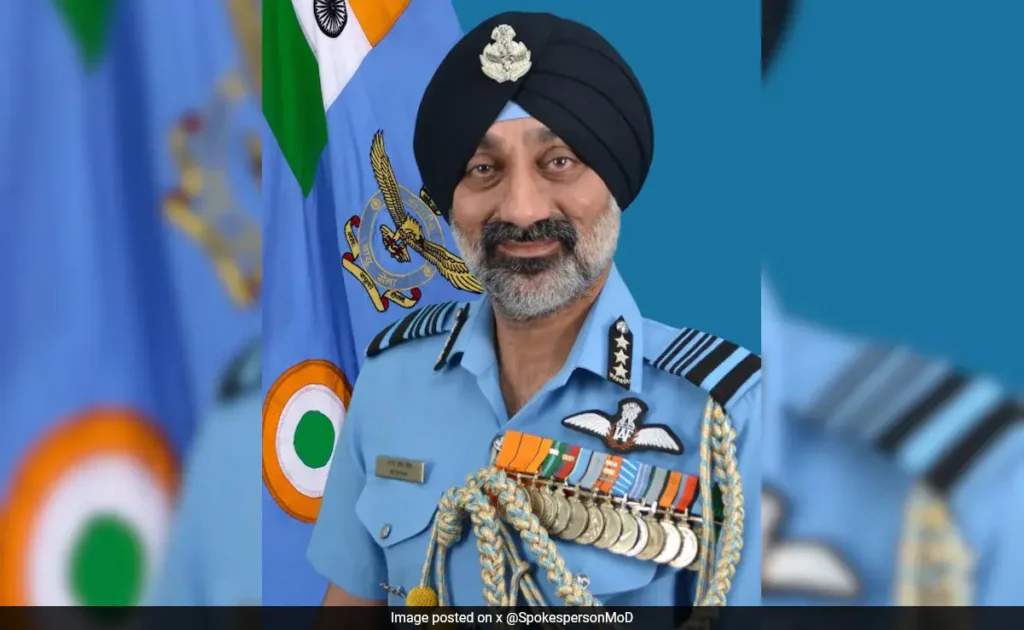
Air Chief Marshal says drones are no longer just used for surveillance but are now powerful weapons in modern warfare
Indian Air Force chief Air Chief Marshal A P Singh on Friday said drones are no longer limited to being the “eyes in the sky” and have now turned into “claws in the sky,” playing an increasingly aggressive and decisive role in modern combat.
Addressing a defence seminar on unmanned aerial systems (UAS), Singh said warfare is rapidly evolving, with drones, autonomous systems and counter-drone technologies becoming crucial on the battlefield.
‘Nature of Warfare Is Changing Fast’
The IAF chief said modern battles are shifting away from traditional concentrated air power towards more decentralised and autonomous warfare.
He stressed that real-time domain awareness and close coordination between all three armed forces are now critical to avoid confusion and friendly fire incidents during operations.
Referring to a recent US military incident involving F-15 fighter jets over Kuwait, Singh said lack of coordination in shared airspace can have serious consequences.
‘Drones Are Now a Major Part of Air Power’
Calling drones an “extension of air power,” Singh said unmanned systems are no longer just for surveillance and intelligence gathering but are now actively involved in offensive operations.
The seminar was organised by Centre for Aerospace Power & Strategic Studies and Indian Military Review.
Referring to recent global conflicts and India’s own Operation Sindoor, he said the role of drones in warfare has expanded significantly in recent years.
‘Counter-Drone Battle Is Constantly Evolving’
Singh described counter-drone warfare as a “cat-and-mouse game,” where every advancement in drone technology forces defence systems to upgrade equally fast.
He warned that if defensive systems fail to evolve, one side can gain a massive advantage in battle.
IAF Highlights Coordination During Operation Sindoor
Speaking about Operation Sindoor, the IAF chief said India’s success was largely due to strong coordination between different forces and the Integrated Air Command and Control System (IACCS), which acted as the central command network.
According to Singh, enemy drones and weapons failed to hit their targets because Indian forces operated through an integrated defence setup.
‘Future Warfare Will Combine Humans and Machines’
The IAF chief said future wars will rely heavily on “manned and unmanned teaming,” where human-operated systems and autonomous technologies work together.
At the same time, he said humans cannot be completely removed from military decision-making anytime soon.
Singh also admitted that improving the survivability of drones during combat remains a major challenge for armed forces around the world.