
Top court says prolonged jail time and delayed trials remain valid grounds for bail even under UAPA
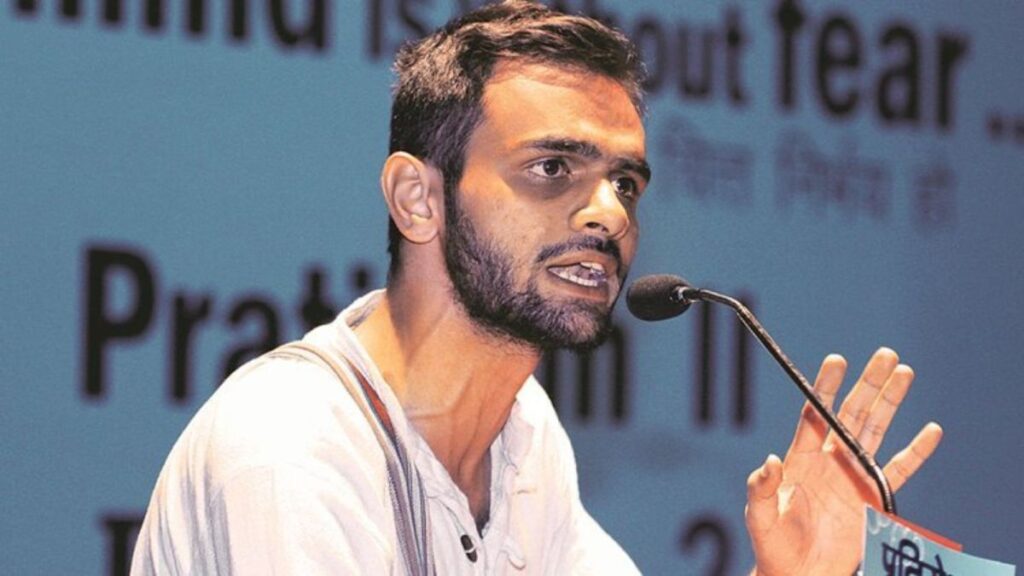
The Supreme Court of India on Monday raised strong concerns over its earlier decision denying bail to former JNU student leader Umar Khalid in the Delhi riots conspiracy case, observing that the judgment may not have properly followed established legal principles on prolonged incarceration under the stringent UAPA law.
A bench of Justices BV Nagarathna and Ujjal Bhuyan made the remarks while granting bail to Syed Iftikhar Andrabi, who had spent more than six years in jail in a terror funding case.
Court Refers To 2021 Landmark Judgment
The bench referred to the Supreme Court’s 2021 ruling in the Union of India vs KA Najeeb case, which held that excessive delay in trial and prolonged incarceration can justify granting bail even in cases under the Unlawful Activities (Prevention) Act (UAPA).
The court noted that this principle was not properly applied while rejecting bail for Umar Khalid and Sharjeel Imam earlier this year in the Delhi riots conspiracy case.
Justice Bhuyan observed that the bench found it “difficult to accept” the interpretation adopted in the Umar Khalid judgment and another UAPA-related ruling involving Gurwinder Singh.
‘Smaller Benches Cannot Ignore Larger Bench Verdicts’
The Supreme Court stressed that judgments delivered by smaller benches are bound by the rulings of larger benches.
The court said judicial discipline requires smaller benches to either follow binding precedents or refer the matter to a larger bench if there is disagreement.
“A smaller bench cannot dilute, bypass or disregard the ratio laid down by a larger bench,” the court observed.
Court Warns Against Turning Jail Into Punishment Before Trial
The bench also criticised the “two-prong test” evolved in another UAPA ruling, where courts required accused persons to first prove that the prosecution’s case lacked prima facie merit before bail could be considered.
The judges warned that such an approach risks turning prolonged pre-trial detention into punishment itself.
The court observed that if the State only has to cross a minimal threshold to oppose bail while trials drag on for years, accused persons could remain imprisoned indefinitely without conviction.
‘Bail Is The Rule, Jail The Exception’
Reaffirming the constitutional importance of personal liberty, the bench said the principle that “bail is the rule and jail is the exception” applies even in UAPA cases despite the law’s stringent provisions.
The ruling could significantly impact several pending bail pleas linked to UAPA cases, including matters connected to the 2020 Delhi riots conspiracy investigation.
Umar Khalid Arrested In Delhi Riots Conspiracy Case
Umar Khalid was arrested in September 2020 over allegations linked to the larger conspiracy behind the 2020 Delhi riots.
The Delhi Police accused him of delivering provocative speeches during anti-CAA protests and alleged that he was part of a planned conspiracy that led to violence in northeast Delhi.
Khalid has denied all allegations and maintained that he was not present in Delhi when the riots broke out.
In January 2026, the Supreme Court denied bail to Umar Khalid and Sharjeel Imam while granting relief to several other accused, including Gulfisha Fatima and Meeran Haider.
At the time, the court held that Khalid and Imam stood on a “qualitatively different footing” from the others and said the allegations against them appeared “prima facie true” under UAPA provisions.