
India Demonstrates Major Nuclear Missile Capability Under ‘Mission Divyastra’
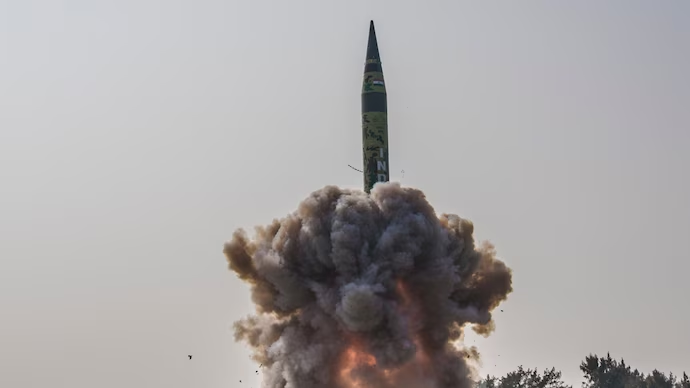
India has successfully carried out another major test of its advanced nuclear-capable missile technology by flight-testing the Agni-5 missile equipped with Multiple Independently Targeted Re-Entry Vehicle (MIRV) capability.
The test was conducted from Dr APJ Abdul Kalam Island off the Odisha coast under the operation named Mission Divyastra.
According to the government, the missile was tested with multiple payloads that were aimed at different targets spread across a large geographical area in the Indian Ocean region.
The successful launch marks another major milestone in India’s strategic missile programme and strengthens the country’s nuclear deterrence capability.
What Makes MIRV Technology So Powerful?
MIRV technology allows a single ballistic missile to carry multiple nuclear warheads and strike several targets independently.
This means one missile can attack different cities, military bases or strategic installations simultaneously. It can also target the same location multiple times with calculated time gaps.
The technology significantly increases the destructive capability of a missile system while making interception far more difficult for enemy defence systems.
Defence sources said the missile can also deploy decoy warheads designed to confuse and bypass enemy ballistic missile defence shields.
Agni-5 Test Sparks Agni-6 Speculation
The latest missile launch triggered speculation on social media that India may have secretly tested the long-rumoured Agni-6 missile, believed to have a range of nearly 12,000 kilometres.
However, defence sources clarified that the recent test was focused specifically on validating MIRV technology integrated with the Agni-5 missile platform.
Officials stated that no government approval has yet been granted for the Agni-6 programme.
India’s Strategic Forces Command To Benefit
The Agni-5 missile is already inducted into India’s Strategic Forces Command, which manages the country’s nuclear arsenal.
During the latest test, the missile’s trajectory and payload deployment were monitored through multiple ground stations and ship-based tracking systems.
According to officials, all mission objectives were successfully achieved during the trial.
The successful test demonstrates India’s growing capability to carry out complex long-range strategic strikes using a single missile system.
India Joins Elite Group Of Nations With MIRV Capability
With this achievement, India joins a select group of countries possessing advanced MIRV missile technology.
Currently, only a handful of nations including the United States, Russia, China, France and the United Kingdom are known to operate MIRV-capable missile systems.
The United States first deployed MIRV technology during the Cold War in the 1970s, followed soon after by the Soviet Union.
How MIRV Changes Modern Warfare
Traditional ballistic missiles generally carry a single warhead aimed at one target.
MIRV-equipped missiles, however, can release multiple warheads at different speeds and directions after re-entering the atmosphere.
Some advanced MIRV systems globally are capable of carrying up to 16 separate warheads in a single missile.
According to strategic experts, these warheads can strike targets located over 1,500 kilometres apart.
The technology dramatically increases the effectiveness of a country’s nuclear deterrence while overwhelming enemy missile defence systems.
MIRV Technology Developed Over Several Years
India has been working on MIRV capability for over a decade.
Although the Agni-5 missile itself was first tested in 2012, MIRV integration remained under development for years.
India first publicly tested MIRV-equipped Agni-5 technology in March 2024, an announcement that was personally made by Prime Minister Narendra Modi.
Sources said the technology was initially developed for the proposed Agni-6 missile programme but was later adapted for Agni-5 after successful testing with Agni Prime systems.
India Also Achieves Miniaturised Nuclear Warhead Capability
The successful test also indicates that India has likely mastered another highly sensitive strategic technology — miniaturised nuclear warheads.
Miniaturisation allows multiple nuclear warheads to fit inside a single missile while maintaining accuracy and strike capability.
Officials said the system uses indigenous avionics, advanced sensors and precision guidance systems to ensure that every re-entry vehicle reaches its designated target accurately.
Major Boost To India’s Strategic Deterrence
The latest Agni-5 MIRV test is being viewed as a major advancement in India’s nuclear deterrence posture, especially amid rising regional security challenges involving China and Pakistan.
Strategic experts believe the capability strengthens India’s second-strike nuclear doctrine and significantly improves its ability to respond to large-scale threats.
The successful test also underlines India’s growing self-reliance in advanced missile and defence technologies.