General Upendra Dwivedi Says India Will Respond Strongly To Any Future Terror Attack
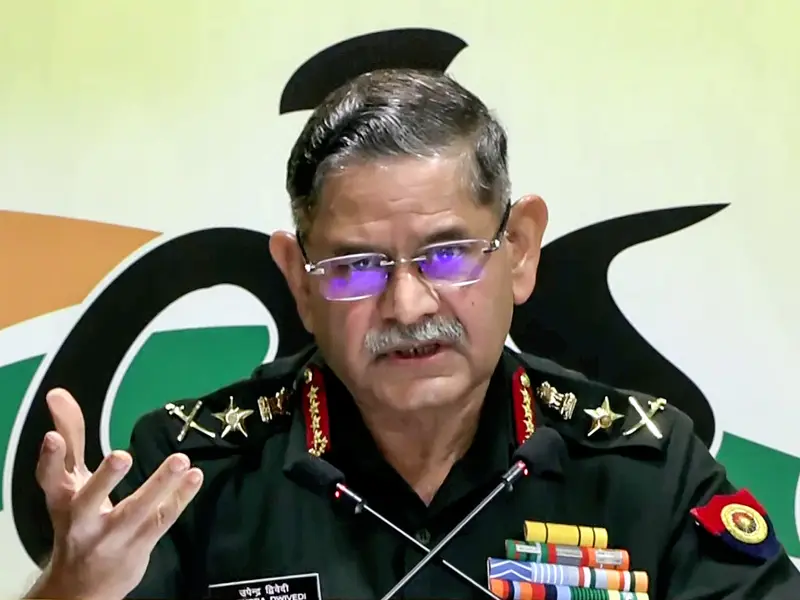
Army Chief Upendra Dwivedi delivered a strong warning to Pakistan, saying Islamabad must decide whether it wants to remain “part of geography or become history” if it continues supporting terrorism against India.
The remarks came during an interaction at the Manekshaw Centre in New Delhi, where General Dwivedi spoke about India’s security posture and the military’s response to future terror threats.
His statement comes shortly after India marked one year of Operation Sindoor, the military operation launched following the deadly Pahalgam terror attack that killed 26 people.
Army Chief Warns Pakistan Against Backing Terror Groups
During the session hosted by “Uniform Unveiled,” General Dwivedi was asked how India would react if circumstances similar to the Pahalgam terror attack emerge again.
Responding firmly, the Army chief said Pakistan cannot continue sheltering terrorists while expecting normal relations with India.
“If Pakistan continues to harbour terrorists and operate against India, then it has to decide whether it wants to remain part of geography or become history,” he said.
The statement is being viewed as one of the strongest public warnings issued by India’s top military leadership in recent months.
VIDEO | Delhi: "… If Pakistan continues to harbour terrorists and operate against India, then they have to decide, whether they want to be part of geography and history or not," says Army Chief General Upendra Dwivedi, at Sena Samvad, a civil-military interaction.
(Full… pic.twitter.com/Ms7Ko1hMQk
— Press Trust of India (@PTI_News) May 16, 2026
What Was Operation Sindoor?
Operation Sindoor was launched by Indian armed forces on May 7 last year after the Pahalgam terror attack in Jammu and Kashmir claimed 26 lives.
As part of the operation, India carried out precision strikes targeting terror infrastructure linked to terror outfits like Lashkar-e-Taiba and Jaish-e-Mohammed inside Pakistan and Pakistan-occupied Kashmir.
The strikes targeted multiple terror launchpads, training camps and operational facilities.
Four-Day Military Escalation Followed
Following the Indian strikes, Pakistan attempted retaliatory attacks targeting Indian military and civilian infrastructure.
This triggered a series of counter-offensives by Indian armed forces as part of the broader Operation Sindoor campaign.
The military confrontation between the two countries lasted nearly 88 hours before Pakistan’s Director General of Military Operations reportedly contacted his Indian counterpart seeking a ceasefire.
Although active hostilities ended on May 10, Indian officials have repeatedly stated that Operation Sindoor has only been “paused” and not concluded permanently.
India Signals Tough New Security Doctrine
Senior Indian military officials have consistently maintained that India will continue responding aggressively to cross-border terrorism.
Earlier this month, Lieutenant General Rajiv Ghai said no terror sanctuary across the Line of Control would remain safe.
“We will hit everything. We will go after everything,” he had said while describing India’s evolving military posture.
Indian officials have increasingly referred to this approach as the country’s “new normal” against terrorism.
India Emphasises Strategic Dominance
The Indian government and military leadership have repeatedly asserted that India maintained strategic dominance throughout the four-day conflict during Operation Sindoor.
Officials claim the armed forces successfully controlled the escalation matrix while responding to Pakistani actions.
The operation is also being projected as an example of India’s willingness to carry out precision cross-border strikes against terror infrastructure when required.
Tensions Continue Amid Security Concerns
General Dwivedi’s remarks come amid continued tensions between India and Pakistan over terrorism and cross-border security issues.
India has repeatedly accused Pakistan of supporting and sheltering terror groups operating against Indian interests, allegations Islamabad has consistently denied.
However, Indian security officials continue to warn that any future terror attack could trigger a swift and powerful military response.